Meta description: Learn Place, Press, Push from Trisutto-certified Animis Racing coaches for smoother swimming, better open water technique and stronger triathlon training.
Does swimming leave you exhausted before the rest of your training has even started?
Perhaps you can swim 400 metres, but it feels like a small aquatic battle. You thrash, breathe hard, lose your rhythm and wonder why all those lengths are not making you faster.
Or maybe you are new to triathlon and the thought of open water swimming makes your stomach perform a convincing impression of a washing machine.
You are not alone.
Swimming is often the discipline where triathletes work hardest for the smallest visible reward. The answer is not always more distance. In many cases, you need a clearer way to organise your stroke.
At Animis Racing, as a Trisutto-certified coaching provider, we use three simple words to help athletes understand freestyle:
Place. Press. Push.
It is not a magic spell. Sadly, there is no swimming cheat code hidden in the settings menu. But it gives you a practical rhythm for creating a more effective stroke, reducing wasted effort and carrying more energy into the bike and run.
If you are swimming regularly but making little progress, the problem may not be your motivation.
You might be working hard with a hand that slips through the water. You might be entering the water with a splash, pulling down air and losing your connection before the stroke has even started. You might also be finishing each stroke too early, leaving useful propulsion behind you.
The result is familiar:
This is why swimming coaching for beginners should focus on skills before suffering. You do not need to turn every session into a heroic test of character. You need to learn how to move through the water with better timing and pressure.
That is where Place–Press–Push comes in.
At the heart of the Trisutto swim approach is a simple sequence:
Place. Press. Push.
Three words. Easy to remember. Surprisingly powerful when they click.
What matters here is not memorising a pile of technical jargon or trying to turn yourself into a robot in lane three. It is understanding that good freestyle has an order to it. First you organise the hand and arm. Then you connect with the water. Then you finish the stroke properly.
That sounds almost suspiciously simple, I know.
But simple is often where the magic lives.
When athletes first hear Place–Press–Push, they usually have one of two reactions. Either, “That sounds too basic to matter,” or, “Hang on… no one has ever explained swimming to me like that before.” Both are fair. And both usually change once you feel the difference in the water.
The real transformation is not just about what the stroke looks like from poolside. It is about what it feels like to you. Less flailing. Less panic. Less of that horrible sense that the water is winning and you are merely being allowed to visit.
Place–Press–Push can help you create a stroke that feels calmer, more connected and more economical. That matters in the pool, and it matters even more in open water when your brain is already busy dealing with sighting, people, chop and the occasional stray limb from Dave in the next wave.
Here is the key point though: this is a concept that sounds simple and becomes powerful through coached feedback.
The fine detail of how you place, when you press and where you finish the push is exactly where swimmers either unlock free speed or accidentally rehearse the wrong thing for months. A cue can be simple. Mastering it rarely happens by guesswork.
So yes, Place–Press–Push is the framework.
But the real gains come when a coach helps you see what you are actually doing, not what you think you are doing. Because those two things are very often about as similar as a race photo and your mental image of yourself looking fast.
Your takeaway: remember the sequence — Place, Press, Push — but do not confuse a useful cue with complete mastery. The concept opens the door. Coached feedback is what helps you walk through it.
Technique is not separate from fitness. It is how you use your fitness.
The Trisutto Training Manual principles favour simple, repeatable training that athletes can apply in the real world. That includes learning to understand effort through the MMM Intensity System:
You can practise Place–Press–Push across these levels. Start with the technique at Easy intensity, where you have enough mental space to notice your hand entry and connection. Move into Moderate and Medium as your rhythm improves.
Mad is not the place to panic and throw technique out of the window. It is controlled hard work. If your stroke falls apart completely, the effort is no longer helping you build the skill you need for racing.
This is also where the 10 Training Rules come into play. Good swimming is built through consistency, sensible progression, specificity and attention to detail. You do not need one spectacular session. You need to repeat useful movements often enough that they become familiar under pressure.
The five D’s help here too:
That last D is often the difference-maker. Are you placing quietly? Are you pressing the water or slipping through it? Are you pushing all the way through the stroke?
Could a better swim really improve your bike and run?
Yes, although not because Place–Press–Push magically adds watts or makes your running shoes faster.
A more efficient swim can help you exit the water with less stress and less wasted energy. You may feel calmer in transition. You may be able to settle into the bike sooner. You may preserve more of the energy and concentration needed for the final run.
That is the real value.
Triathlon is one sport, not three unrelated events glued together with race numbers. A swim that costs too much can affect everything that follows. Improving your swimming technique is therefore one of the best ways to maximise your overall race performance.
For beginners, the gain may be confidence and simply finishing the swim without panic. For experienced age-group athletes, it may be holding a better line, reducing stroke count or arriving at the bike ready to work.
The low-hanging fruit is often not swimming harder.
It is learning to waste less.
Place–Press–Push gives you a framework to take into your next session.
Not a full do-it-yourself manual. Not a magic fix from one blog post. A framework.
That is deliberate.
Because the real breakthrough is not in reading the words. It is in feeling them properly, applying them at the right moment and getting feedback on the details that are very hard to judge on your own. Your breathing, balance, timing, open water skills and race-specific demands still have to fit together. Trying to piece that together solo can be a bit like playing a boss level with the controller upside down.
If you want the full picture rather than the teaser trailer, explore Animis Racing’s swim coaching resources. As a Trisutto-certified coaching provider, we help athletes of all levels build confidence and improve their technique using clear, jargon-free coaching grounded in the Trisutto methodology.
You can also learn more about our practical approach to triathlon swimming through the Swim the Triathlon course.
Your swim does not need more random effort.
It needs the right cues, the right feedback and the right coaching eye.
Place. Press. Push.
Three simple words.
And if you want to discover what they really do to your swimming, come and let us show you.
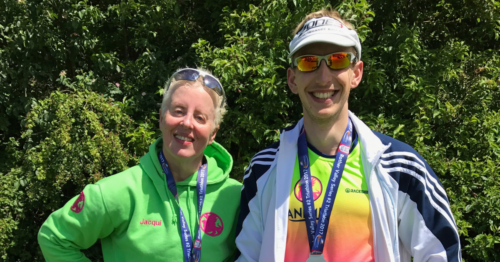
We're Coaches Jacqui and Oliver Saxon, the Animis Coaching Team.
We are a mom and son coaching team who have changed our lives through the sport of triathlon. We aim to break down the mysteries of triathlon training and show you, the avid traithlete, how simple and flexible it can be so triathlon training really does become part of your lifestyle and not just a hobby.