Meta description: Discover how Trisutto’s Speed Through Endurance approach builds triathlon speed without burnout, using personalised training plans and smart progression.
You’re training hard, but do you actually feel faster?
Perhaps you’re squeezing in early-morning swims, turbo sessions after work and weekend runs around family life. You’re putting in the hours. Yet race day arrives and your speed seems to have gone missing, somewhere between the fourth interval and the washing-up.
Worse, you may feel constantly tired. Your easy sessions are no longer easy. Your hard sessions are more survival exercise than quality training. The season you hoped would unlock your potential starts to look like a long slog towards burnout.
There is another way.
At Animis Racing, as a Trisutto-certified coaching provider, we use the principle of Speed Through Endurance to help athletes become faster by building the right endurance underneath their speed. It is not about training slowly all year. It is not about collecting heroic mileage like Pokémon.
It is about developing the systems you need, in the right order, and arriving at race day strong, efficient and fresh enough to use your fitness.
Speed Through Endurance means building the ability to hold speed for longer, rather than simply chasing speed in short bursts.
A fast 100-metre swim does not automatically make you fast over 1,500 metres. A powerful bike interval does not guarantee a strong bike-to-run transition. A quick 5K does not mean you can run well after the swim and bike.
Triathlon speed must survive fatigue.
That is why Trisutto training combines:
The aim is not to smash yourself in every session. The aim is to make the whole week work.
This matters particularly if you have limited training time. You do not need more random effort. You need better use of the hours you already have.
Here is the uncomfortable question: can too much hard training make you slower?
Yes.
If every session becomes a test, you gradually lose the ability to train consistently. Your body never gets the chance to adapt. You may see impressive numbers for a few days, then your motivation, technique and performance all begin to wobble.
This is where many athletes become trapped. They train in the grey zone: not easy enough to recover, not hard enough to create a clear performance stimulus.
Trisutto coaching avoids that muddle by using the simple MMM Intensity System:
The name is memorable because the principle is practical. You should know what each session is trying to achieve.
An Easy session should not quietly become Moderate because your training partner has had an extra coffee. A Mad session should not become a frantic attempt to prove your worth to a bicycle computer.
The intensity must serve the purpose.
Traditional training often tells athletes to build a huge endurance base first, then add speed later.
Trisutto uses Reverse Periodisation, and this is where Speed Through Endurance starts to flip conventional thinking on its head.
Most athletes assume endurance creates speed only after months of plodding around. Trisutto looks at it differently. First, you develop the ability to move well, apply force and handle controlled quality. Then you teach your body to carry that speed further, deeper into fatigue and closer to race demands.
That does not mean ignoring endurance. Far from it. It means endurance is not treated as endless slow training for the sake of looking busy. It becomes the engine that lets your speed survive when everyone else is fading.
That is the real meaning of Speed Through Endurance.
You are not just trying to become quick for a few flashy minutes. You are building the kind of speed that still shows up when the swim gets messy, the bike leg bites back and the run starts asking awkward questions.
It is especially powerful for triathletes because race-day speed is never fresh speed. It is tired speed. Controlled speed. Durable speed.
And yes, there is a very specific way Trisutto-certified coaching puts this together. But this is one of those moments where I am not going to sell the farm in a blog post.
Because the magic is not in copying one sexy session from the internet. It is in knowing how to apply the system to your life, your limiter and your race build-up so that the pieces land at the right time.
It is a bit like hearing the trailer and wanting to watch the whole film. You get the idea straight away, but the full payoff comes from seeing how it is structured properly.
For a useful overview of how Trisutto structures training phases, see the guidance on reverse periodisation for triathlon.
You do not need to redesign your entire life to start training more effectively.
Begin with one question before every session:
What is the main purpose today?
That sounds almost too simple, but it is where many athletes go wrong. They blur sessions together, chase effort for the sake of effort and wonder why everything feels flat.
The Trisutto approach keeps session purpose clear and repeatable. That is one of the reasons the system works so well in the real world. You are not guessing. You are not throwing darts in the dark. You are building toward something.
The exact structure, though, is where personalised coaching matters most. The difference between “interesting training” and “effective training” usually comes down to timing, restraint and knowing what to leave out.
The Trisutto swim philosophy includes the Place-Press-Push technique:
It is simple, but simple does not mean easy. Improving how you apply force in the water can make each stroke more productive. You are not just flapping harder and hoping for a miracle.
What matters here is not memorising a handful of example sets from a blog. It is understanding how technique, endurance and controlled speed are layered together so your swim holds up when you are under pressure. That is exactly where proper coaching earns its keep.
Trisutto cycling often includes low-cadence or “stomping” bike training to build the strength needed to produce useful force.
Done well, this is not random grinding and suffering for bragging rights. It is targeted work with a clear reason behind it. The same goes for Speed Through Endurance on the bike as a whole: the goal is not to look impressive on one session, but to ride strongly enough that you still have a run left in your legs.
The bike should make you a better triathlete, not merely an excellent person at turning pedals while seated.
Running is where impatience often becomes expensive.
A little more speed can feel exciting, but injury can remove weeks or months from your season. Trisutto running places great importance on frequency, consistency, sensible progression and listening to the body.
In other words, the system is designed to help you become harder to break and more able to express speed when it actually counts. The specific programming is always the tempting bit people want to skip to, but the real secret is how the pieces are sequenced for the individual athlete.
Speed Through Endurance only works when you respect the wider Trisutto principles. These are the 10 Training Rules I want you to keep in mind:
That final rule may be difficult in an age of endless training content. There is always a new zone, gadget, challenge or guru promising to unlock your inner world champion before breakfast.
Sometimes the best upgrade is repeating the basics properly.
Training is not only a physical process. It also requires the right mindset.
The Trisutto approach can be understood through the 5 D’s:
Notice that none of these means “train as hard as possible”.
A busy business owner may not have 20 hours a week to train. That does not mean meaningful progress is out of reach. It means the plan must respect work, family, sleep and real life.
The detail is in choosing what matters most.
What is the value of arriving at race day fast if you are exhausted, injured or mentally finished?
A sustainable plan gives you more than fitness. It protects your opportunity to use that fitness.
By progressing carefully, separating training purposes and using the MMM Intensity System, you reduce the temptation to turn every day into a competition. By using Reverse Periodisation, you avoid wasting your early season on excessive volume that may not match your current needs. By adding longer race-specific work at the right time, you prepare for the demands of your event without trying to do everything at once.
That is the real bang for your buck.
You train with enough quality to improve, enough endurance to last and enough restraint to keep moving forward.
You do not need to guess how much Easy, Moderate, Medium or Mad work belongs in your week. You do not need to copy a professional athlete’s schedule and hope your knees accept the plot twist.
A personalised plan should reflect your race distance, experience, available time, strengths, weaknesses and current fatigue. That is where an online triathlon coach can make a genuine difference.
At Animis Racing, our personalised triathlon training plans follow Trisutto principles while adapting the work to the athlete in front of us. Whether you are completely new to the sport, preparing for your first event or chasing an age-group podium, we focus on clear guidance, sustainable progression and measurable improvement.
If this idea of Speed Through Endurance has made you realise your current training might be leaving speed on the table, that is the point.
The principle is simple enough to understand. Applying it properly is where things get interesting.
If you want to see how Trisutto-certified coaching would shape this around your training, your schedule and your next race, contact Animis Racing to start the conversation. You can also learn more about our online coaching approach.
Build the endurance. Unlock the speed. Then discover how much more there is when the system is tailored to you.
That is where the real breakthrough starts.
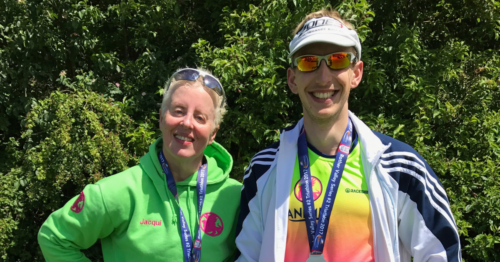
We're Coaches Jacqui and Oliver Saxon, the Animis Coaching Team.
We are a mom and son coaching team who have changed our lives through the sport of triathlon. We aim to break down the mysteries of triathlon training and show you, the avid traithlete, how simple and flexible it can be so triathlon training really does become part of your lifestyle and not just a hobby.